Metabolic Care Has Become an Enterprise Risk Intelligence Challenge
Metabolic care has moved beyond the clinic and into the boardroom. Here is how metabolic risk intelligence helps leaders turn scattered signals into decisions they can defend.
Metabolic risk intelligence is becoming essential as metabolic care moves beyond the clinic and into the boardroom. For leaders accountable for cost, quality, and access, the question is no longer whether to invest — it is whether every metabolic care decision can be identified, targeted, tracked, measured, and defended.
Metabolic care is no longer just a clinical program. For health plans, employers, health systems, and population health teams, it is an enterprise-level risk challenge that touches clinical outcomes, pharmacy spend, operations, compliance, and financial accountability.
Metabolic risk intelligence is the ability to connect patient data, risk models, intervention history, outcomes, and cost signals so teams can make earlier, clearer, and more defensible decisions about metabolic care.
It is not about collecting more data. Most organizations already have plenty. It is about turning scattered information into a shared evidence base that clinical, financial, operational, data, and compliance teams can act on together.
Why metabolic care has changed
Metabolic care used to live mostly inside diabetes clinics, weight-management programs, pharmacy oversight, or chronic disease management initiatives.
That world has changed.
GLP-1 therapies, value-based contracts, remote monitoring, chronic disease performance goals, and rising cost pressure have made metabolic care a strategic concern. Decisions about who gets access to high-cost treatments, how long they stay on them, and how success is measured now affect budgets, equity efforts, compliance reviews, and executive planning.
For broader context on the scale of diabetes and obesity as population health challenges, see resources from the CDC on diabetes and the CDC on obesity. The shift also reflects the broader move toward accountable, value-based care models described by CMS.
Different teams are asking different versions of the same question:
- Executives want to know whether high-cost therapies are reaching the right people.
- Clinical leaders want to know whether decisions reflect patient risk and evidence-based care.
- Finance teams want to understand whether outcomes justify investment.
- Data teams want to know whether the evidence can be trusted.
- Compliance teams want to know whether decisions can be documented and defended.
Those are not separate concerns. They point to one larger question:
Can your organization make metabolic care decisions with enough visibility, confidence, and accountability?
For many organizations, the answer is still no.
The issue is not lack of signals
Most healthcare organizations already hold many of the signals needed to understand metabolic risk: claims, EHR data, labs, pharmacy fills, prior authorization records, utilization, care-management notes, device data, engagement metrics, and social or access context.
The problem is that those signals often live in separate systems and serve separate teams.
A clinician may see labs and diagnoses. A pharmacy team may see medication patterns. A finance team may see utilization and cost. A population health team may see cohort trends. A compliance team may see documentation gaps.
Each view is useful. None is complete.
When visibility is fragmented, decisions become harder to explain and defend. A patient may be approved for a high-cost therapy without enough context around readiness, comorbidities, or expected benefit. A program may show activity without proving impact. A payer or employer may see spend rising without a clear explanation of whether outcomes are improving.
Fragmented visibility creates fragmented decisions.
What makes metabolic risk intelligence different
Traditional reporting looks backward. Dashboards summarize what happened. Metabolic risk intelligence helps teams decide what to do next.
- A dashboard might show that GLP-1 utilization is increasing. Risk intelligence helps explain which cohorts are driving that trend, whether they match intended criteria, how outcomes are changing, and where program strategy may need to adjust.
- A dashboard might show medication adherence. Risk intelligence connects adherence to risk, comorbidities, utilization, outcomes, and total cost.
- A dashboard might show program enrollment. Risk intelligence helps determine whether the right patients were enrolled in the first place.
That distinction matters. Metabolic care is not simply a reporting challenge. It is a decision challenge.
From fragmented signals to defensible decisions
Metabolic risk rarely comes from one issue. Diabetes, obesity, cardiovascular risk, renal risk, behavioral health needs, medication adherence, and social barriers often overlap and compound over time.
That is why whole-patient visibility is central to metabolic risk intelligence. It connects the signals needed to understand a patient’s risk and care journey — then turns that connected view into better decisions.
A simple model:
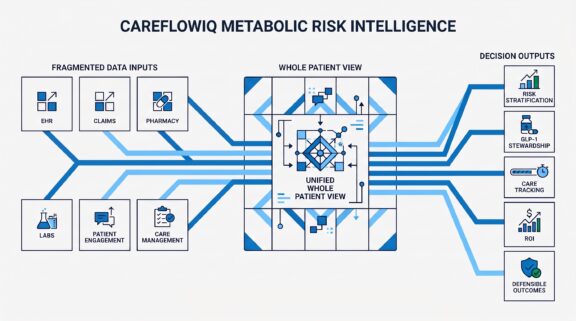
This is not integration for its own sake. It is how teams answer the questions that matter: who is at rising risk, who is likely to benefit, what intervention is appropriate, whether outcomes are improving, and whether the decision can be explained.
Each layer builds on the last. Skip a layer and the decisions at the bottom get harder to trust — and harder to defend.
The decisions metabolic risk intelligence should improve
The value of metabolic risk intelligence is practical. It should help organizations improve the decisions that carry the most clinical, financial, and operational weight.
For example:
- Who should be prioritized for metabolic intervention?
- Who meets evidence-based criteria for GLP-1 or other high-cost therapies?
- Who needs additional support to persist with treatment?
- Which cohorts are improving clinically, financially, or both?
- Which access barriers are affecting outcomes or equity?
- Which decisions need stronger documentation?
- Which interventions should be continued, adjusted, expanded, or stopped?
The goal is not blunt restriction or unchecked access. The goal is appropriate, evidence-based, equitable targeting — supported by evidence that clinical, budget, data, and compliance teams can trust.
Where Milliman CareFlowIQ™ fits
Milliman CareFlowIQ™ helps organizations turn fragmented metabolic health data into a shared evidence layer for clinical, financial, operational, and compliance decisions.
It brings together whole-patient data, risk stratification, patient segmentation, treatment tracking, prior authorization insight, and Milliman-backed analytics to help teams answer practical questions:
- Who is at risk?
- Who is likely to benefit?
- What changed over time?
- Which interventions are working?
- Can the decision be defended?
The value is not another dashboard. It is decision infrastructure for metabolic care programs that must be measurable, explainable, and sustainable.
What leaders should do next
Organizations do not need to solve every metabolic care challenge at once. But they should start by asking whether their current operating model can support the decisions ahead.
A practical first step is to assess five areas:
- Risk model — Which clinical, financial, operational, and compliance risks matter most?
- Data readiness — Which data sources are connected, governed, and usable?
- Patient segmentation — Can teams identify who needs which intervention, when, and why?
- Outcome tracking — Can the organization monitor clinical, utilization, cost, and engagement signals over time?
- Decision defensibility — Can decisions be documented, explained, and reviewed?
Without those foundations, organizations may have data, dashboards, and programs — but still lack the evidence needed to act with confidence.
The bottom line
Metabolic care has outgrown fragmented workflows and backward-looking reports. As treatments become more powerful, costly, and visible, organizations need a clearer way to connect risk, action, outcomes, and cost.
That is the role of metabolic risk intelligence.
It gives healthcare leaders a better way to identify risk, target interventions, monitor performance, and defend decisions. The organizations that build this capability now will be better equipped to manage metabolic care as what it has become: an enterprise risk domain.
Conclusion
Is your metabolic care strategy defensible? Request a Milliman CareFlowIQ metabolic risk intelligence assessment to see how your organization can identify high-risk cohorts, monitor metabolic care interventions, measure cost and outcome impact, and document decisions with evidence your teams can trust — request your assessment →.
Frequently asked questions
What is metabolic risk intelligence?
Metabolic risk intelligence is the capability to connect patient data, risk models, intervention history, outcomes, and cost signals so organizations can make earlier, more defensible metabolic care decisions.
Why is metabolic care an enterprise risk issue?
Metabolic care now affects clinical outcomes, pharmacy spending, operational workflows, compliance expectations, and financial accountability across the organization.
Why are dashboards not enough?
Dashboards summarize activity. Metabolic risk intelligence connects risk, interventions, outcomes, and cost into a shared evidence base that supports actual decisions.
Why does whole-patient visibility matter?
Whole-patient visibility gives teams the full context behind metabolic risk, including clinical, pharmacy, financial, behavioral, engagement, and access factors.
What should a metabolic risk intelligence assessment evaluate?
It should evaluate data readiness, risk stratification, patient segmentation, outcome tracking, intervention performance, and decision documentation.