Why Medicaid Metabolic Health Programs Need Connected Data They Can Act On
Medicaid metabolic health programs need connected data to identify risk earlier, coordinate interventions, measure outcomes, monitor equity, and explain whether public dollars are improving care. This article shows where fragmented data quietly becomes operational risk — and a practical way to find the gaps before the next budget review.
Medicaid leaders can know what they spent on metabolic care and still not know whether the program is working. That is the problem.
Claims may show utilization. Pharmacy data may show GLP-1 use. Labs may show A1c movement. Eligibility files may show churn. Care management records may show outreach attempts. MCO encounter data may show service patterns weeks or months after decisions were made.
Each source tells part of the story. None tells enough on its own.
For leaders responsible for Medicaid metabolic health programs, that gap is not a technical inconvenience. It affects targeting, quality, equity, cost, and accountability. If the data cannot show who needs support, what action was taken, whether outcomes changed, and where the evidence came from, the program becomes hard to manage and harder to defend.
What is connected data in a Medicaid metabolic health program?
Connected data in a Medicaid metabolic health program means linking clinical, claims, pharmacy, eligibility, care management, encounter, and social needs information so teams can understand risk, intervention activity, outcomes, equity, and cost in context.
The goal is not simply to collect more data. The goal is to help Medicaid leaders identify who needs support, coordinate action earlier, measure whether outcomes are improving, and explain whether public dollars are producing value.
The real issue is not whether the organization has data. Most Medicaid teams have plenty. The harder question is whether the data is connected well enough to support decisions before the next reporting cycle, budget review, MCO conversation, or oversight meeting.
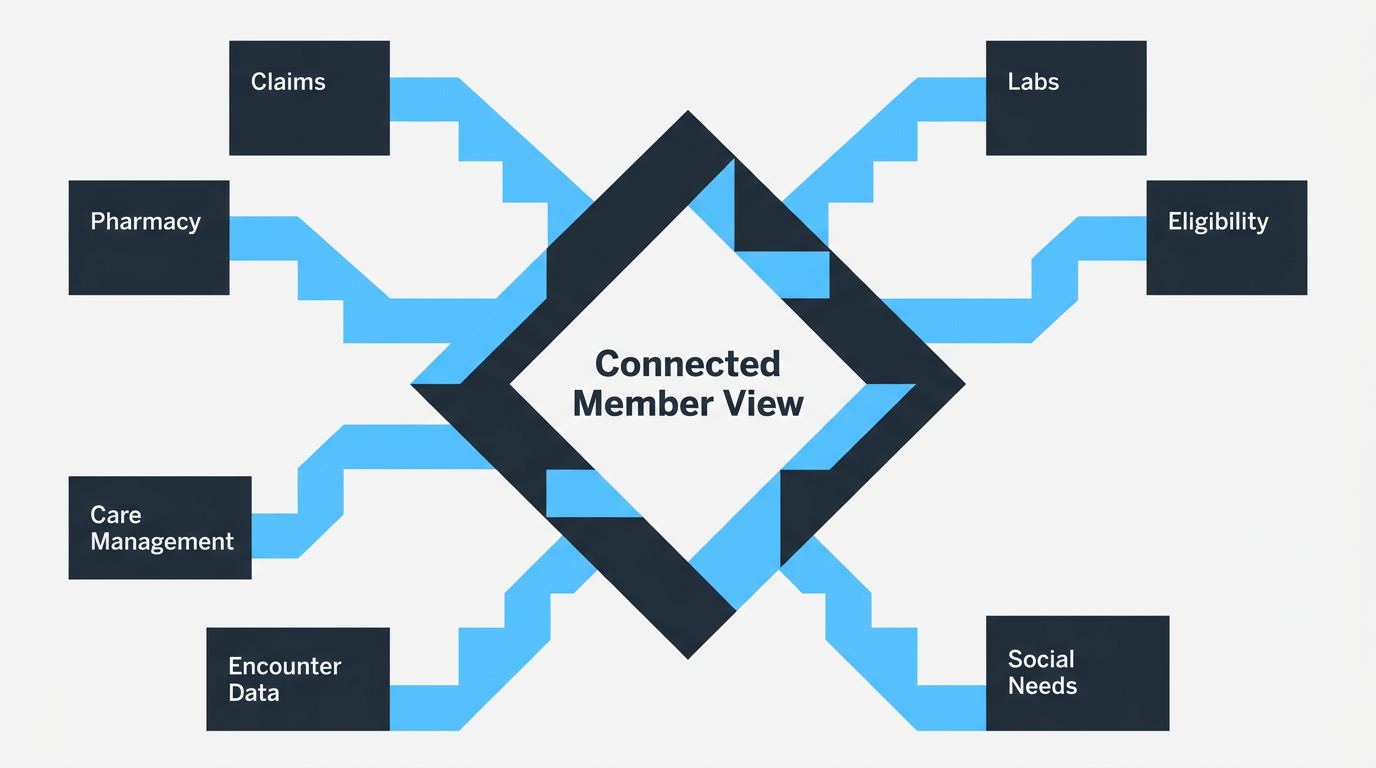
Connected data helps Medicaid teams understand risk, intervention activity, outcomes, equity, and cost in context.
Fragmented data turns program management into reconstruction
Consider a member with uncontrolled diabetes.
They may become eligible for care management, start a GLP-1, miss follow-up outreach, experience a gap in primary care, and later appear in claims after an avoidable emergency department visit. In one system, they look clinically high-risk. In another, they look like a pharmacy trend. Somewhere else, they look like an outreach gap. In a finance review, they may appear only as rising cost.
By the time the full picture is assembled, the moment to intervene may have passed.
That is where fragmented data becomes operational risk.
People can be doing the right work and still be working from an incomplete view. Reports can be delivered on time and still fail to answer the question leadership actually needs answered:
Are we improving outcomes for the right members, in the right way, at a cost we can explain?
That question matters because Medicaid metabolic health programs are not judged only on activity. They are judged on whether public dollars are producing better outcomes, whether access gaps are being addressed, whether high-cost interventions are appropriate, and whether the program can withstand scrutiny from CMS, state leadership, MCO partners, providers, procurement teams, and the public.
Connected data changes the quality of the decision
Connected data gives Medicaid teams a clearer line from risk to action to outcome.
It helps leaders see whether the members with the greatest need are being identified early enough. It shows whether interventions are actually reaching them. It makes it easier to compare outcomes across geography, race, ethnicity, language, disability, rural access, and social risk. It also gives program and budget teams a stronger way to understand whether high-cost interventions are producing measurable value.
The point is not to create another dashboard. The point is to make the member story easier to follow.
A metabolic health program may need to connect MMIS claims, MCO encounter data, pharmacy and PBM files, lab feeds, eligibility records, HIE or EHR data, care management activity, provider information, and social needs data. The value is not in seeing more fields on a screen. The value is in understanding what those signals mean together.
When those sources remain separate, every team works from a different angle. Program leaders see performance one way. Quality teams see measure movement another way. Finance sees cost and utilization. Clinical teams see risk. Data teams see gaps in definitions, timing, matching, and provenance.
A connected view does not remove the need for judgment. It gives people better evidence for the judgments they already have to make.
Why metabolic health makes the problem harder
Metabolic conditions rarely move in a straight line. Diabetes, obesity, cardiovascular risk, kidney disease, behavioral health needs, food insecurity, medication access, transportation, and rural provider capacity often interact over time. A single data source can miss that pattern.
A member may appear adherent in one system and disengaged in another. A therapy may look expensive before outcomes are visible. A rural access barrier may show up later as avoidable utilization. Equity differences may stay hidden until reporting is too late to change the intervention.
That is why metabolic health programs need more than after-the-fact reporting.
They need a way to see whether the program is changing the trajectory for members who need help most. They need to know whether outcomes are improving equitably. They need to understand whether intervention activity is connected to clinical movement, utilization change, and cost impact.
Without that connection, the conversation becomes reactive. The program team explains what happened. The quality team explains what moved. The finance team explains what was spent. The data team explains what is missing. Leadership is left trying to reconcile the story after decisions should already have been made.
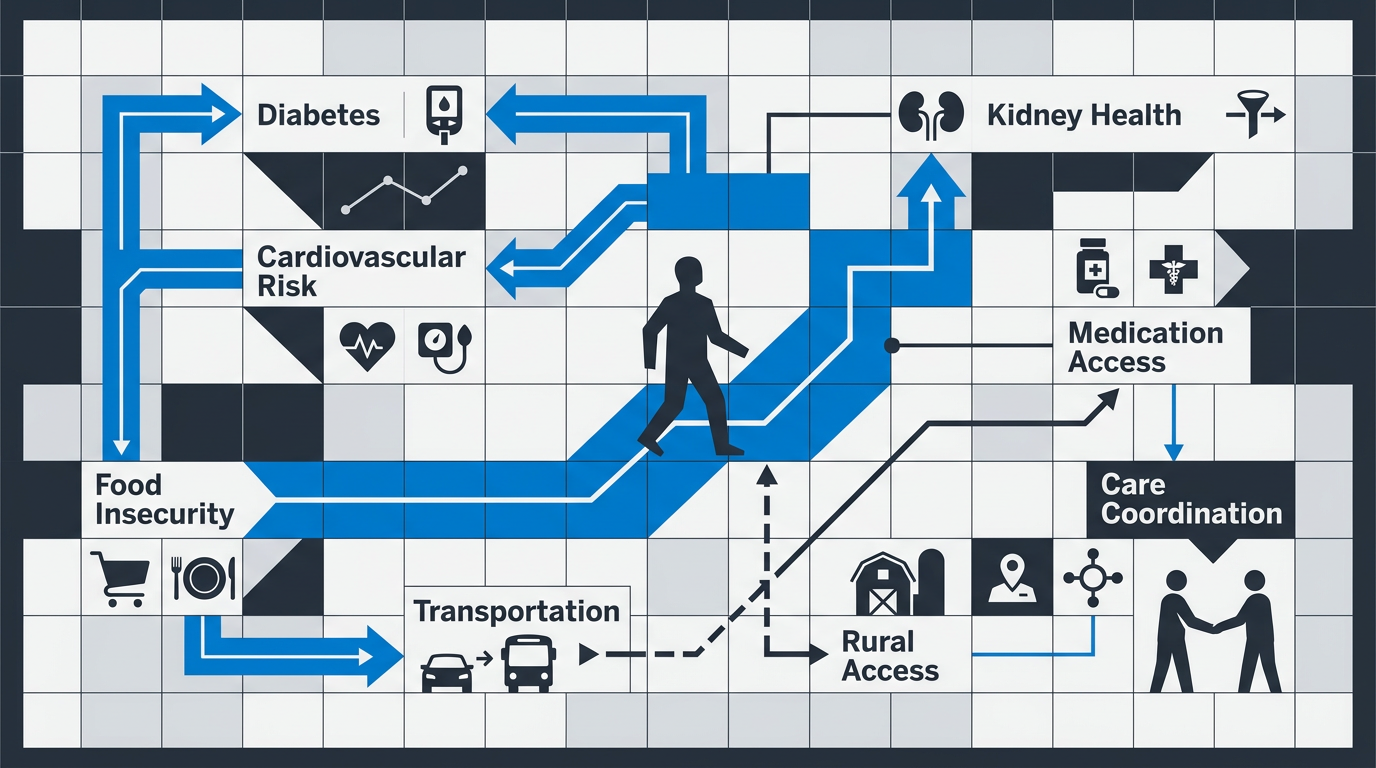
Metabolic health programs are harder to manage when diabetes, cardiovascular risk, kidney health, medication access, food insecurity, transportation, rural access, and care coordination interact across separate systems.
A practical way to find the gaps
A Medicaid team does not need to begin with a full modernization program.
Start with one cohort that already matters. It could be members with uncontrolled diabetes. Members using GLP-1 medications. Members with rising cardiometabolic risk. Rural members with preventable emergency department utilization. Members eligible for care management who are not engaging.
Then follow a small sample through the system:
- Can the team see when risk was identified?
- Can it see what intervention was offered?
- Can it connect pharmacy, lab, claims, eligibility, and care management activity?
- Can it show whether outcomes changed?
- Can it explain the measure clearly enough that program, finance, quality, clinical, compliance, and data teams would all trust the answer?
The gaps usually show up quickly. Sometimes the issue is missing data. Sometimes it is delayed data. Sometimes the information exists, but different teams define the same measure differently. Sometimes the problem is provenance: leaders cannot tell where a number came from, how it was calculated, or whether it can withstand review.
That exercise is valuable because it turns an abstract data problem into a management problem. And management problems can be prioritized.
What Medicaid leaders should expect from data infrastructure
A metabolic health program needs data infrastructure that can do more than collect and move information.
It should help teams identify risk earlier, connect intervention activity to outcomes, monitor equity and access differences, understand cost movement, and explain the evidence behind a decision.
That requires more than interoperability alone. Moving data between systems is necessary, but it is not the same as making the data usable. Medicaid teams also need trusted definitions, clinically meaningful context, identity matching, source transparency, and a way to connect patient, program, intervention, and outcome data across the lifecycle of care.
The practical test is simple:
Can the team see enough of the member story to make a better decision this month?
If the answer depends on manual joins, delayed extracts, spreadsheet reconciliation, or tribal knowledge across departments, the organization is still managing metabolic health from fragments.
The takeaway
Medicaid metabolic health programs do not struggle because leaders lack reports.
They struggle when the data does not connect early enough, clearly enough, or credibly enough to guide action.
Connected healthcare data helps teams move from after-the-fact reporting to active program management. It gives leaders a better way to see risk, coordinate interventions, measure outcomes, understand equity, and defend the investment.
Milliman CareFlowIQ helps organizations turn fragmented clinical, claims, and program data into usable, defensible intelligence. It connects available data sources, applies clinically meaningful context, identifies risk, supports coordinated action, measures outcomes, and helps teams explain clinical and financial impact.
For Medicaid metabolic health programs, that is the difference between reporting what happened and managing what should happen next.
Next step: choose one priority cohort, follow it end to end, and see where your data breaks.
Common questions
What data sources are needed for Medicaid metabolic health programs?
Medicaid metabolic health programs often need to connect MMIS claims, MCO encounter data, pharmacy and PBM files, lab feeds, eligibility records, HIE or EHR data, care management activity, provider information, and social needs data. The exact mix depends on the program, but the goal is the same: connect enough of the member story to support timely decisions.
Why is fragmented data a risk for Medicaid programs?
Fragmented data makes it harder to see whether members are being identified early, whether interventions are reaching them, whether outcomes are improving, and whether spending can be explained. It can also hide access, equity, and care coordination gaps until after the reporting period or budget review.
How should Medicaid leaders evaluate their data infrastructure?
Medicaid leaders can start by following one priority cohort through the system. If the team cannot connect risk identification, intervention activity, outcomes, equity factors, cost movement, and data provenance without manual reconciliation, the program is still being managed from fragments.